Zombie satellites
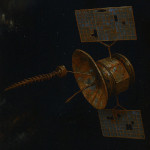
Ancient weather satellites, early satellite experiments, old relay and telecommunication satellites... pieces of space debris,
floating above our heads, woken up decades later...
But how did they start transmitting again? Which ones are there? Can I receive them? If so, how? How do they behave, how
interesting are the signals they still produce? Iam gonna try and answer some of those questions in this article.
How?
First, how do these old satellite missions start emitting signals years, decades after silence? There are multiple causes
for such a behavior of these old satellites. Some more common ones include the satellite simply not be shut down,
or shutdown incorrectly after completing its mission, battery problems, or rather the aging of spacecraft batteries is another way of how some of
these ancient satellites come back to life. The simplified explanation for this battery related reboot
of sorts is that after the spacecraft is powered off,
or its batteries simply go bad, pretty much shorting its power supply, the solar panels still produce voltage and current, even the early solar panels
used on the very early missions still
can produce some amount of power. With the batteries in the spacecraft simply being too old and degraded
to a point of not charging anymore, the solar panels still push some amount of power/current though them. After years or decades of failed
charge
cycles, these batteries might become open circuit allowing direct path of power from the solar panels to the spacecraft electronics.
Some less typical, more rare events can also include static charge bulding up on top of the old spacecraft
and either interacting with its metal body
or its internal, even if degraded, electronics. This kind of *transmission* usually lasts for fractions of a second, but can still generate some kind of
signals either at random frequencies or frequencies that the
spacecraft originally operated on.
What do these satellites transmit?
Zombie satellites transmit a large range of signals. Ranging from something like a sporadic, unstable carrier emissions, all the way to fully, or almost
fully working telemetry transmissions or even what used to be data/instrument downlinks.
Most common transmitters that come online are some
kind of telemetry or tracking beacons. The reason is rather simple. It's because those telemetry or tracking beacon transmitters would have been
*on* or transmitting by default, with the satellite config
in default configuration (which a sat would be likely to use after being rebooted due to
becoming a zombie. Having no power for a long time). While other transmitters might also be fully operational, things like transponders,
instrument downlinks or other types
of radio downlinks usually require some kind of ground command to make them enabled, instead
of just transmitting by default when there is power.
Which ones are there?
The amount of zombie satellites is growing all the time, either because they just start transmitting again, or they did so in the past, but just in an
unusual not well checked band that they only get found years later. This means that there still might be some
undiscovered satellites, transmitting
in uncommon, or rather not so well looked after bands still waiting to get found.
The main point of this blog post isn't really to list all of the currently transmitting zombie satellites, since those can get out of date
(will talk about this a bit later), but instead show some good examples that are well known, and some behavior from those.
Let's start with the most interesting stuff, shall we?
NOAA-2
This is one of the rare cases where a zombie satellite actually transmits some kind of instrument downlink, or what used to be one at least.
In this case, the analog HRPT (High Resolution Picture Transmission) downlink is active that used to contain imagery from its
imagers
and a bit of calibration telemetry that's still present. The main imager instrument, VHRR (not to be confused with AVHRR from newer
NOAA satellites) simply isn't operating anymore, as one would expect. In this image you can also see a behavior that's pretty common
for a lot of
zombie satellites, the signal appearing and then either getting weaker and completely disappearing a bit later. The satellite is slowly spinning,
meaning its solar panels get sunlight only for a certain time. When operational, losing sunlight wouldn't be
a problem because batteries would
power the satellite for the duration of the lack of power from the panels. But as one could expect, the batteries are long dead on this ancient zombie
satellite, launched all the way back in 1972.
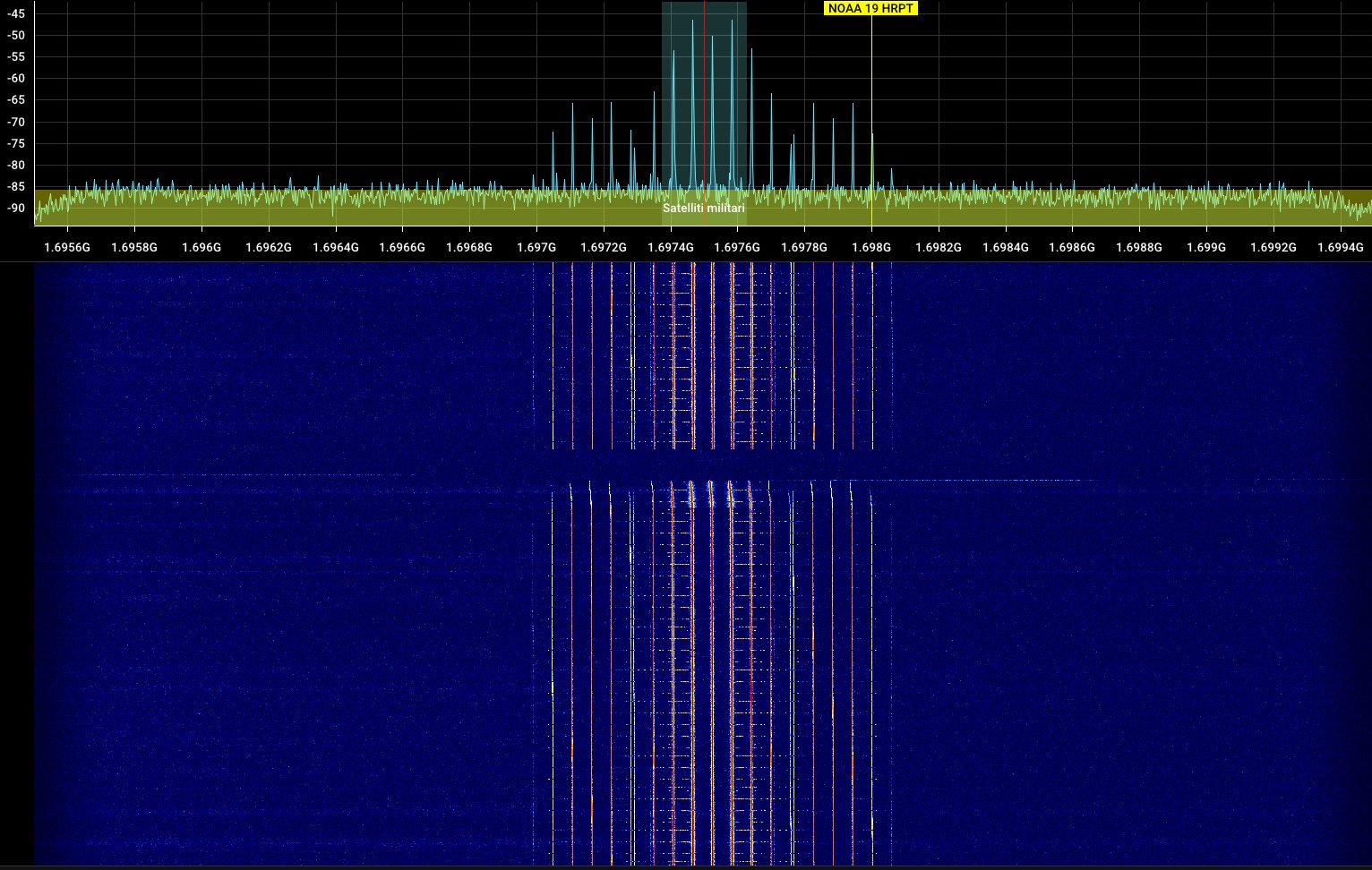
image credit goes to lego11
Still doesn't mean that the signal is undecodable, decoders have been written for this satellite's HRPT signal to get at least the remaining data
in the signal decoded.

once again image credit goes to lego11
The satellite transmits at 1697.5MHz, meaning if you already have an existing HRPT receiving setup, you will also be able to receive this satellite.
Iam not gonna go into too much detail about how to do that. If you want a guide on how to receive and decode this
satellite, have a look at lego11's website, NOAA-2 satellite reception and decoding.
That's for a satellite that transmits still mostly intact instrument downlink, in this case, what used to be Earth imagery. But what about a satellite transmitting telemetry? Well let's take a look at that next.
TRANSIT 5B-5
Transit 5B-5. This satellite has a story in itself. While named 5B-5, and its TLEs also being valid, there is some recent-ish strong evidence
that the spacecraft was swapped with a different satellite at some point. It might have been when digitizing all the data
over the years.
But which spacecraft was it swapped with? Transit 5E-5. But anyways, let's get to the point, its transmissions.
This satellite still transmits telemetry, or at least mostly intact one. This satellite isn't much newer than NOAA-2, in fact, it's about 8 years
older,
launched in 1964. Over the years, the telemetry behavior from this satellite changed a bit. It is believed that a clock divider failed on this satellite,
so when comparing the telemetry that can be received from it today to old recordings from back when it was
freshly launched or still actively used,
the telemetry is 2x the speed today. As far as I know, this satellite, unlike the other usual zombie satellites, never really stopped transmitting,
its main mission failed 19 days after launch, and after that, it just wasn't monitored
until noticed still transmitting years later.
Only transmits when the sun is shining on its solar panels. Has interesting signal characteristics when its exiting or entering a shadow
and doesn't get enough power from the sunlight.
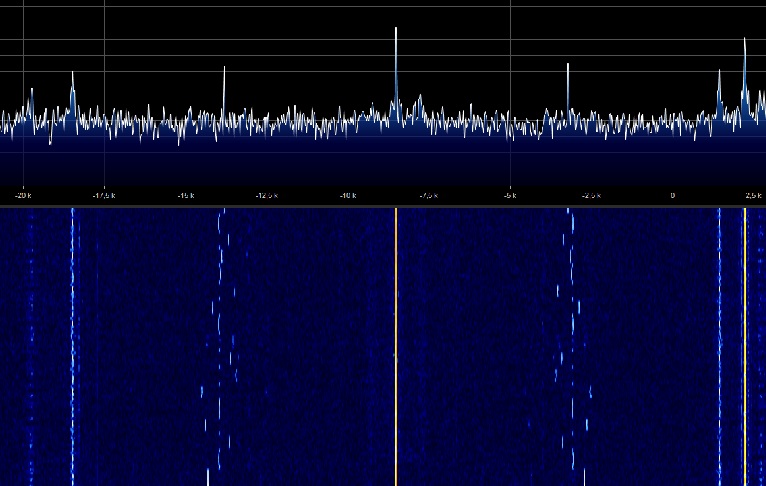
There still isn't really any decoder for this satellite that puts out any useful data. This is really due to two factors, one being the degraded systems
of the satellite, which sometimes just produce bad repeating values, but mainly lack of much documentation about the
telemetry system and what
it contains. Receiving this satellite is pretty easy compared to NOAA-2, all you really need is a V dipole and an SDR that's sensitive enough
and capable of receiving 136.65MHz, the frequency which the satellite transmits on. Something like an RTL SDR
will do nicely.
You can of course push it further and use a Yagi with an LNA, but this isn't really required, as this satellite is rather strong.
Its signal did get weaker at one point, but seemed to have recovered to full strength since.
Now let's again go down in level, and take a look at a satellite that only transmits a carrier wave without any modulation.
Tiros-N
This satellite is one of the more interesting zombie satellites with just a carrier. It is quite stable and instead of transmitting on only one band like
a lot of other zombie satellites, it transmits on two. 137.77MHz, that being VHF and 1698MHz, 1702.5MHz and 1707MHz
(yes, all three),
that being the L band. This satellite should also be rather loud on both VHF and L band, so it also is an interesting target for someone interested
in receiving zombie satellites. Of course, just like NOAA-2 and Transit, it only transmits when in direct
sunlight.
Once a satellite becomes a zombie, does it have to stay transmitting forever? Ofcource not, it's an old equipment, in some cases,
over 60 years old, so these satellites can go silent or get weaker (was the case for Transit for a while).
NOAA-9
NOAA-9 was a pretty well known zombie satellite in the 137MHz VHF band transmitting at 136.77MHz. Its signal wasn't always super stable,
but usually when it had enough sunlight, it did put out quite a nice carrier there. But at some point, something finally gave up
in the satellite,
be it the transmitter, power supply, or something else, and it went completely silent. It might be possible that right now it's just super weak, but a Yagi
with an LNA not being enough to see any traces of it doesn't back this theory up that much.
Will it start transmitting again someday?
Maybe, as it started transmitting years back as a zombie satellite, it might also resume its transmissions yet again at some point in the future.
Tho that depends on the technical state of the satellite, noone really knows if the
reason it stopped transmitting is temporary or permanent.
Whats next?
I might put up a list of zombie satellites, their frequencies, and waterfall images/recordings at some point in the future, if i do, i will be sure to leave
a link to it here and slowly add any missing images here. For now, hope you got some useful (or at least interesting)
information out of this little blog
and enjoyed the little longer read. And of course, thanks for reading :)